
What We're Working On
Hi!
So, I guess this is the first post on the corporate blog. It's probably about time for me to introduce myself.
Hey, I'm Jesse Vincent. I'm the founder and CEO of Prime Radiant. In previous lives, I've started a small keyboard company. I've started a small ticketing system company. I helped run VaccinateCA, the nonprofit that helped Californians figure out where they could get COVID shots. I created an email client called K-9 Mail for Android that got adopted by Thunderbird and is now Thunderbird for Android. I used to be responsible for the Perl programming language. And I've done some other stuff.
For the past year, I've been relatively nose down working with coding agents. In the AI world, I'm probably best known for Superpowers, an agentic skills framework and development methodology that I built initially for Claude Code and that now runs on a whole bunch of other agent platforms.
Around the beginning of this year, I founded Prime Radiant.
Prime Radiant isn't exactly "The Superpowers Company", but being the CEO means that I get to spend corporate resources supporting and giving away Superpowers.
Broadly speaking, we're doing AI stuff. Everything we make is built with agents.
The first time I made the transition to "agentic" development, it was soul-crushing.
I hated it.
It seemed like I was throwing away a lot of what made me a productive engineer. My job had been writing and reading code.
I'd come home at the end of the day, and feel like I hadn't done anything at work.
Because I hadn't written any code.
What did I spend my day on? I helped figure out what "we" were working on. I did some coaching. Sometimes there might have been code review but really there wasn't even very much of that. My job was to figure out what we were doing, to write about it in plain English, and to help make sure that folks were able to turn it into reality.
I was still working in an 80x24 terminal window, but the closest I got to coding was planning, pointing out errors, and begging for better test coverage.
It was a really rough transition.
Once I got through it, it was amazing. Suddenly, the things that I wanted to do just happened. I had five engineers doing what I asked. And over time, they got better at it. At least in part because I got better at managing them.
Pretty quickly, I came to realize that the code was always a means to an end. I wanted to ship product to people. I wanted to make stuff. And I was doing more of that than I could do by myself.
That was a couple decades ago.
Fast forward to 2025.
Making the transition to agentic development over the past year has felt pretty natural for me, at least partially because I've done it before. I've found myself having one of the most prolific periods of my career. My GitHub graph has been basically solid green for the past year.
I haven't been writing any code. The last code I wrote was three lines of shell script in October, 2025. (I haven't been reading much code, either, but that's a story for another day.) I'm working harder on software than I've worked in a long time. And I'm making lots of stuff.
I'm actually making so much stuff that I lose track of the projects I'm working on and where I got to on them.
And that's what brings us to today's blog post.
Like many other folks, I've built a bunch of tools that help me comprehend Claude Code's logs. Back in October, the first one was my episodic memory plugin for Claude Code. It imports your conversation history into a place that Claude can see it and indexes it and makes it searchable. And then it gives Claude a skill and a sub-agent to do that searching. Buried inside the plugin was a tool that rendered those transcripts as HTML.
Last month, we put together a centralized corporate agent log archive, so that we could see how each of us was prompting our agents, and everyone would be able to access historical records of the development work that is creating the software we're building. It comes with a Claude Code skill to auto-sync your transcripts on exit, and it is designed to run in some central place that your entire team can get to. As a heads up, you should run it behind a firewall or on a tailnet, because this makes everything in your transcripts public to anybody who can get to the website.
claude session viewer should actually support Codex sessions too now, but it got named what it got named.
Neither of these tools really answer the question that I've been finding myself overwhelmed by lately:
What did I work on today?
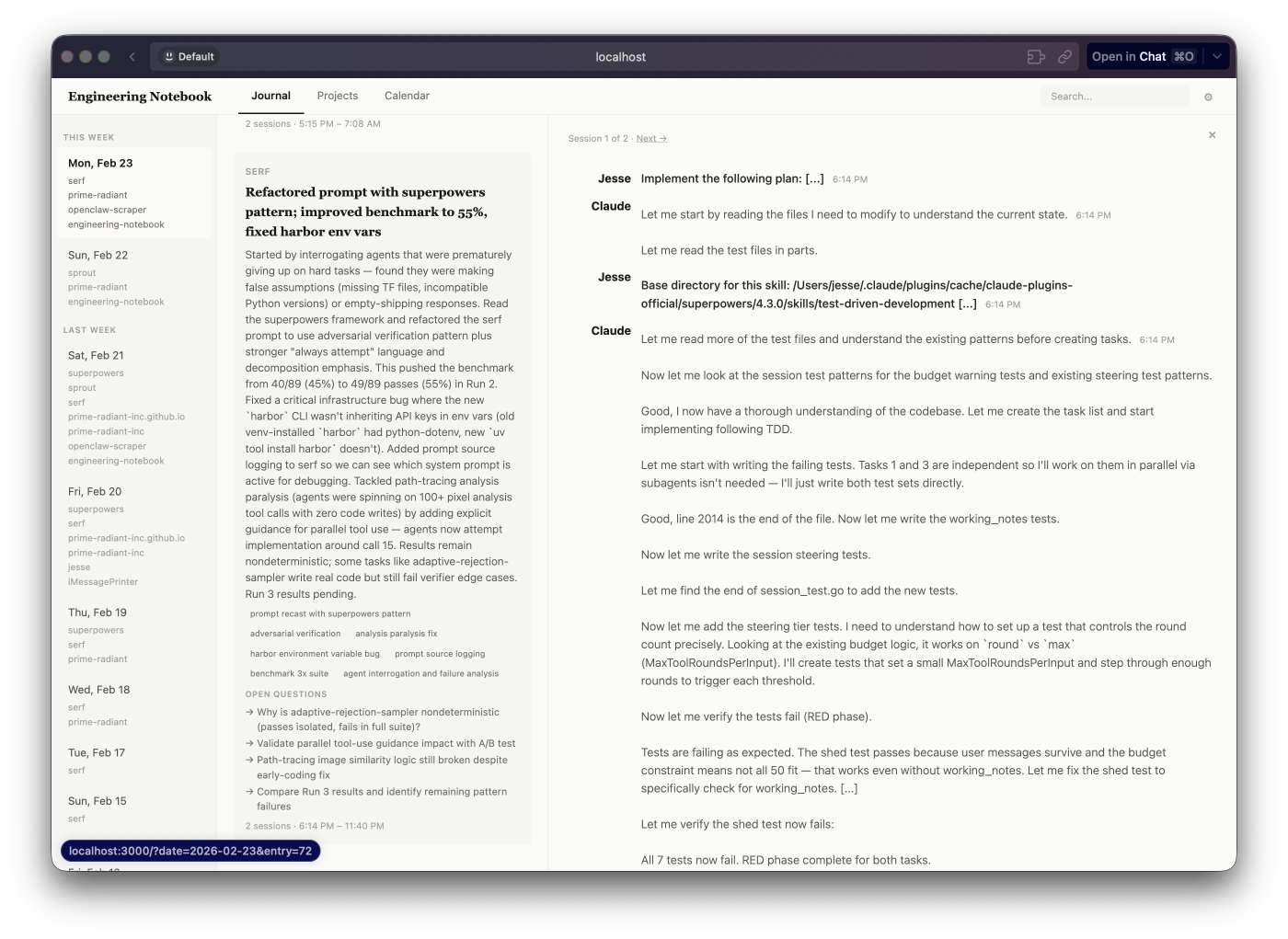
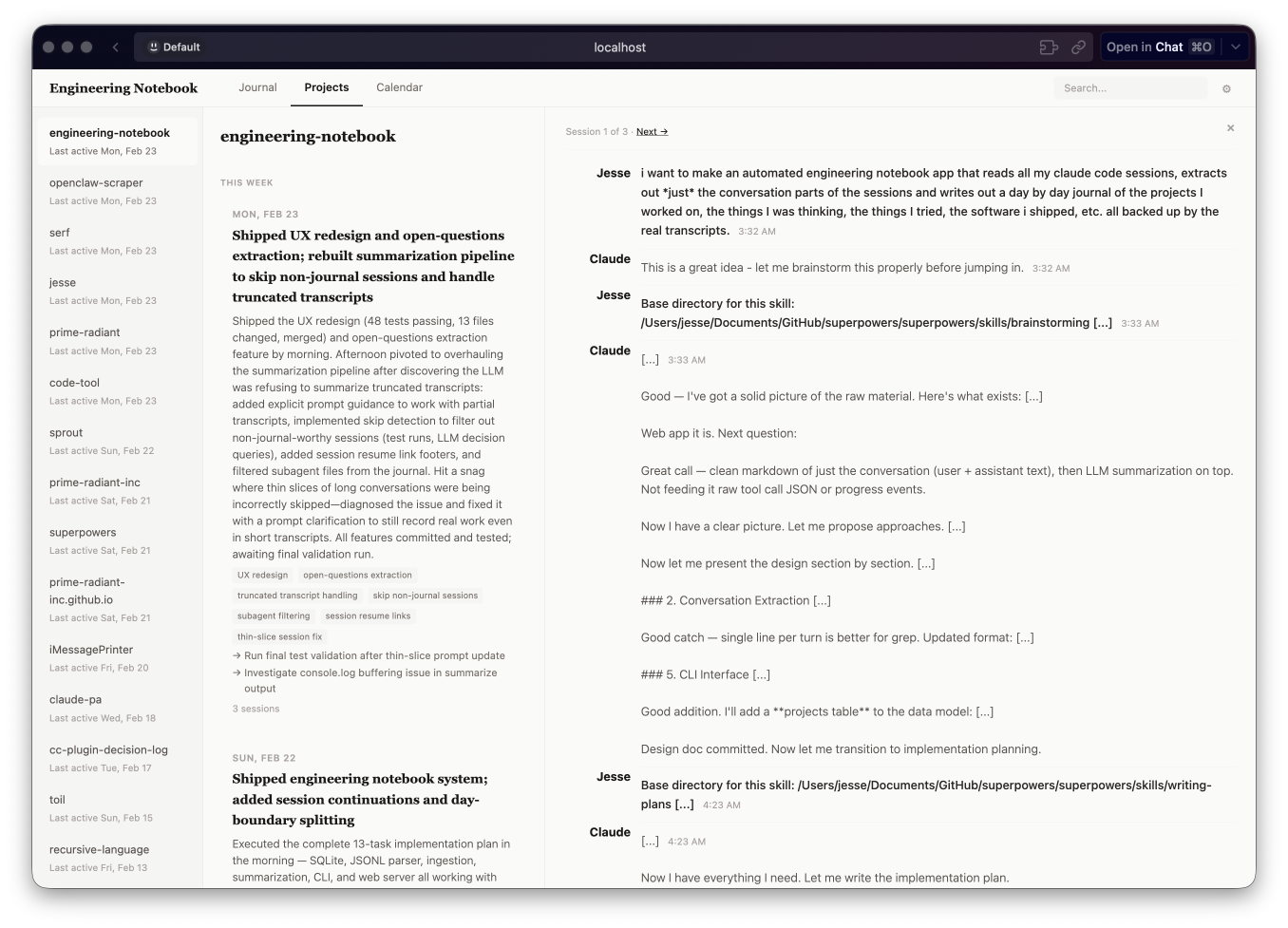
And so over the weekend, I started putting together an automatic engineering notebook. It syncs all of my Claude Code sessions from all of the places that I run them into a central archive on my laptop. It uses the Claude Agents SDK to summarize what I did in each session and whether there are any open threads or unresolved issues that were obvious from the conversation. And then it presents that information in a few different ways:
In a journal view that shows day by day what projects I worked on and what I did on them.
In a view by project showing me what I did on each project day by day.
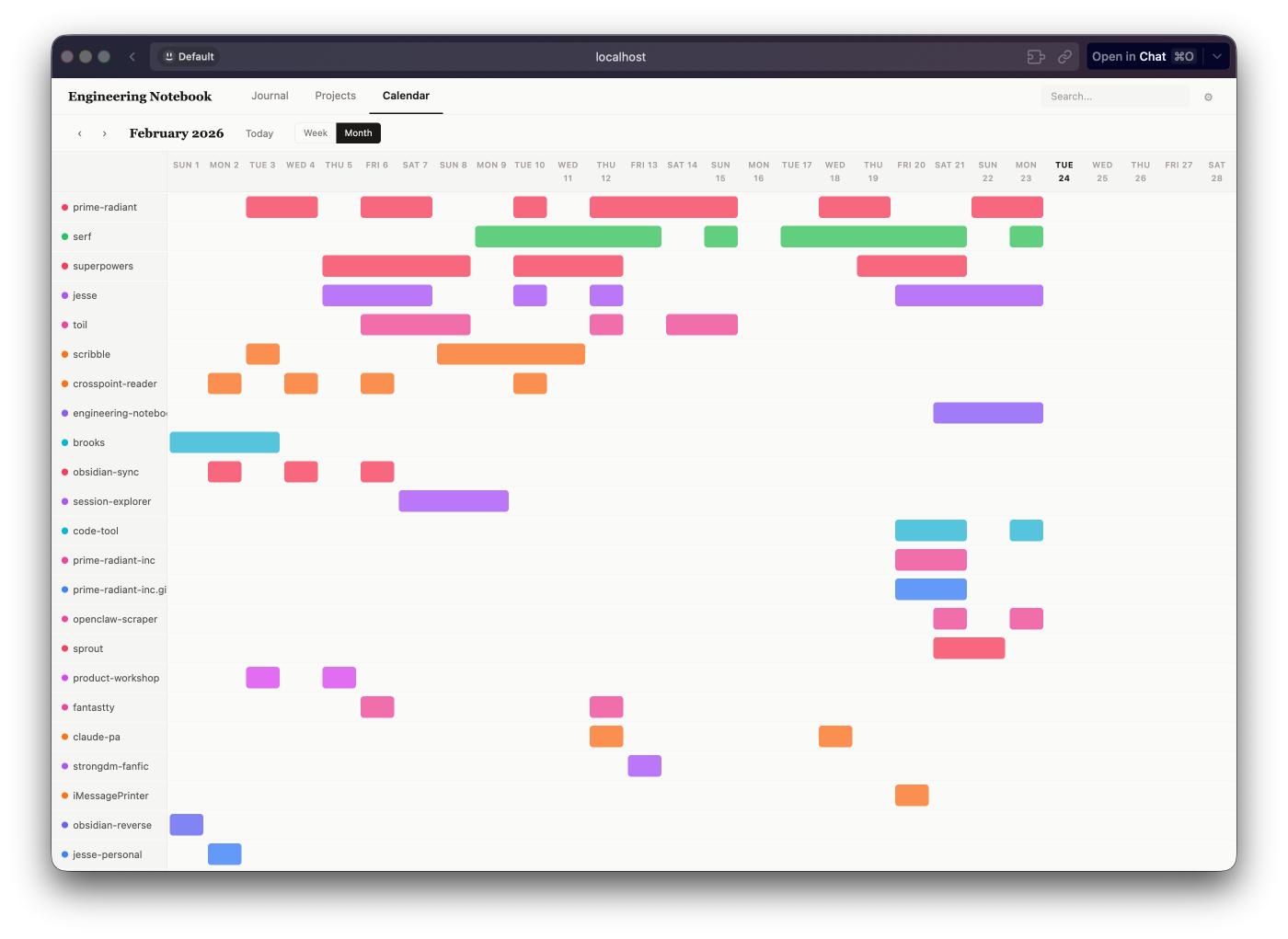
In a calendar view, so I can get a sense of the cadence of my projects.
And there's also an iCalendar feed that I can subscribe to in my desktop calendar app to see all of this data as a retrospective calendar.
All of those views make it easy for me to tell you that today I worked on scaffolding a new coding agent design, using terminal-bench to tune another coding agent (currently at about a 65% pass rate), running a malware audit against the openclaw skills hub, implementing engineering-notebook, and migrating a couple of our internal tools from AWS Fargate to EC2. Over the past month, it looks like I've worked on at least 23 different software projects across Swift, Typescript, Rust, Go, Python, and C++.
engineering-notebook is implemented in Typescript and runs locally on your computer with Bun.
It's open source and available on GitHub.
And, if you've read this far, I'm only a little sorry that the title of this blog post was a bit of a tease.
We've got a handful of other projects that we're getting ready to open source. Many of them are tools for folks who make software, but not a single one of them has been coded by a human.